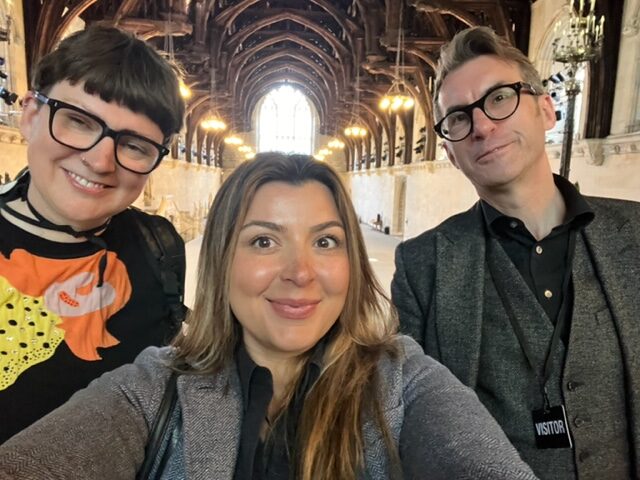
On 21st April 2022 visual arts organisations spoke to members of the DCMS Select Committee about some of the challenges facing the visual arts sector. Those giving evidence were Sanaz Amidi, CEO of Rosetta Arts and CVAN London Steering Group member, Keith Merrin, Director of Tyne and Wear Archives and Museums and Clare Reddington, Chief Executive of Watershed. The session represents an important step forward in helping MPs understand the way our sector works..
The group responded to questions ranging from our understanding of the word, ‘culture’ through to nuanced interpretations of what the levelling up agenda means across England. The witnesses spoke passionately about the benefits that engaging with the visual arts bring to the communities in which they operate and highlighted the agile and imaginative manner in which organisations are adapting to survive.
Session Highlights
Sanaz Amidi highlighted the challenges facing Rosetta Arts which serves one of the most deprived boroughs in the country. She stated that when local authorities are well resourced they are able to empower community arts organisations. In return, arts organisations can help local authorities to realise shared goals in relation to adult social care, children and young people and regeneration projects. This work is often done in consultation with others such as Newham’s Anti Poverty Alliance. In relation to education, Sanaz explained that it has become harder for arts organisations to deliver their educational offer over the past ten years because the number of funded arts courses is decreasing. She asserted that arts education is a social justice issue and stressed the importance of removing barriers to accessing arts education for those who can not afford to pay for courses.
Keith Merrin, Director of Tyne and Wear Archives and Museums welcomed the valuable Museum and Galleries Exhibition Tax Relief (MGETR) but urged for this relief to be extended to cover online exhibitions and activities. He also drew attention to how visual arts organisations suffer as a result of the business rates regime and urged policymakers to address this. Keith detailed how Tyne and Wear Archives and Museums has adapted to its funding from local authorities being roughly halved over the past ten years. This has included reducing opening hours and staffing levels. In response to questions about the term, ‘culture’ Keith said that his organisation’s research showed that the term ‘creativity’ was more meaningful for young people.
Watershed’s Chief Executive, Clare Reddington spoke about how Watershed has maximised project funding to create long term benefits in Bristol, citing the example of Pervasive Media Studio, which was established fourteen years ago thanks to project funding. On the issue of climate justice, Clare Reddington told the committee that Watershed creates toolkits for other creative businesses to be able to understand their carbon impact. Clare also drew attention to Watershed’s work on inclusion. The organisation is currently working to understand how individuals’ lived experience affects their experience of cultural provision and is using this information to develop toolkits so that others can benefit from their work.
Watch the oral evidence session. Read the oral evidence session transcript.